How One Japanese City Rebuilt Itself Into a Blueprint for Human-Scale Living
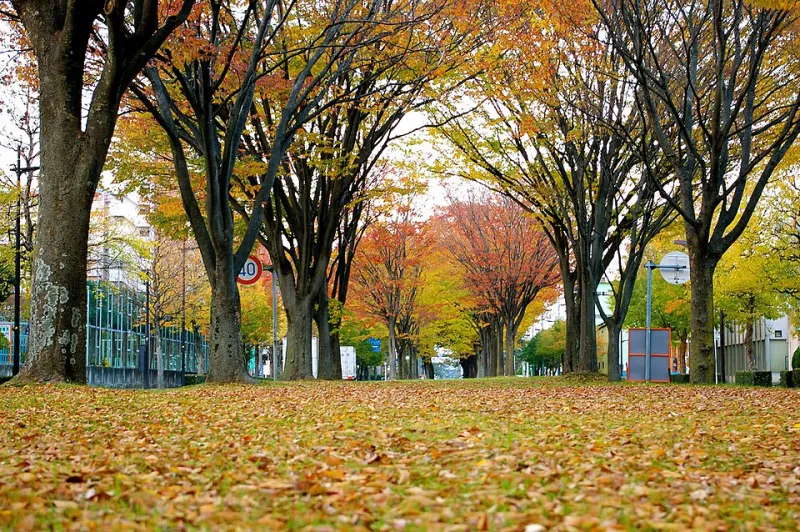
Photo: Kumamushi, CC BY-SA 3.0, via Wikimedia Commons
If you asked most Americans to name a city that's figured out urban planning, you'd probably get answers like Copenhagen, Amsterdam, maybe Portland on a good day. Sendai, Japan almost never comes up. That's a gap worth closing.
This mid-size city in Tohoku — population roughly one million, known in the US primarily for its Tanabata festival and beef tongue — has been rebuilt from near-scratch twice in the last century. Once after World War II bombing leveled much of its core. Once again, in spirit and infrastructure, after the catastrophic 2011 Tohoku earthquake and tsunami tested every system the city had. Both times, Sendai made choices that prioritized human connection over commercial efficiency. The results are quietly remarkable.
Wide Streets Were a Radical Act
After the war, city planners made a decision that would have seemed counterintuitive in most postwar reconstruction contexts: they made the streets wider, not narrower. While other Japanese cities were racing to pack in as much commercial density as possible, Sendai's rebuilders laid out broad boulevards with generous sidewalks and, critically, tree-lined medians that would eventually become the city's defining visual character.
Jozenji-dori, the most famous of these corridors, is now a zelkova-tree canopy that functions as both a promenade and an outdoor event space. It hosts the Pageant of Starlight in winter, jazz festivals in summer, and on any given Tuesday, just people walking. Not shopping. Not commuting. Walking.
"The street as public room — that concept was baked into the reconstruction from the beginning," explains one urban design researcher who has studied Sendai's postwar planning. "Most cities think of streets as transportation infrastructure. Sendai thought of them as social infrastructure. That's a fundamentally different starting point."
Green Space as Emergency Infrastructure
Sendai's parks and green corridors aren't just aesthetic choices. After 2011, when the tsunami devastated coastal communities in Miyagi Prefecture and sent shockwaves through Sendai's own infrastructure, the city's open spaces became emergency staging grounds, community gathering points, and psychological refuge simultaneously.
This wasn't an accident. Sendai has long maintained what planners call a "green network" — a connected system of parks, river corridors, and tree-lined streets that links neighborhoods from the city center out to the forested hills on its western edge. During normal times, this network functions as recreational space and urban cooling. During crises, it becomes something more: a distributed system that doesn't have a single point of failure.
Post-2011, Sendai doubled down on this approach. Coastal buffer forests were replanted and expanded. Neighborhood parks were redesigned with disaster-response functions built in — water storage, emergency signage, elevated ground. The city essentially encoded resilience into its landscape.
Neighborhoods That Actually Function as Neighborhoods
Talk to residents in Sendai's older districts — places like Kawauchi or the streets around Kitayashiro — and a common theme emerges: people know their neighbors. Not in a nostalgic, small-town way, but in a practical, everyday way. They run into each other at the shotengai (covered shopping street). Their kids walk to the same school. There's a physical logic to the neighborhood that creates accidental community.
This isn't something that happened organically. It was designed. Sendai's reconstruction planning, and its subsequent development guidelines, have consistently resisted the kind of large-format commercial development that tends to hollow out neighborhood retail in favor of edge-of-city big-box stores. The result is that walkable local commerce has survived in Sendai in ways it hasn't in many comparable Japanese cities, let alone American ones.
"When you can walk to a butcher, a pharmacy, and a coffee shop within five minutes of your apartment, you're going to run into people you know," says one Sendai resident who moved from Osaka a decade ago. "That sounds simple, but it's actually really hard to engineer. Most cities get it wrong."
What the 2011 Response Revealed
The earthquake and tsunami that struck Tohoku in March 2011 was one of the deadliest natural disasters in modern Japanese history. Sendai was not in the direct path of the worst coastal destruction, but the city absorbed enormous impact — infrastructure damage, displacement, and the psychological weight of being the regional hub for a shattered coastline.
What the disaster revealed, paradoxically, was how much Sendai's design choices had actually worked. Community networks that existed because of walkable neighborhoods activated quickly for mutual aid. Civic spaces that had been maintained as genuine public rooms became coordination centers. The city's relative decentralization meant that when parts of the infrastructure failed, other parts kept functioning.
Urban planners who studied the response have noted that social cohesion — the kind that comes from people actually knowing and trusting their neighbors — was a measurable factor in recovery outcomes. Sendai's design had been quietly building that cohesion for decades.
The Lesson for American Cities
None of this is magic, and none of it is uniquely Japanese. The principles Sendai has applied — mixed-use neighborhoods, connected green infrastructure, streets designed for people rather than just cars, resistance to commercial monoculture — are legible in any urban context. They're also, in most American cities, consistently deprioritized in favor of development models that generate faster short-term returns.
Sendai isn't perfect. It has its own struggles with suburban sprawl, demographic aging, and the economic pressures that affect every mid-size city in the developed world. But it has something that's genuinely rare: a track record of rebuilding in ways that made life measurably better for the people who live there.
That's not a small thing. That might actually be the whole thing.